The Sapphire of the Silences: A Portrait of the Himalayan Blue Poppy

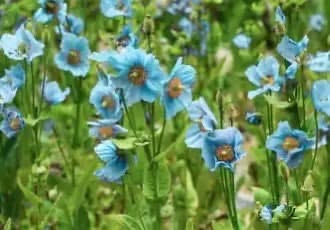
In the Himalayan heights, where the cold winds sweep, a celestial blossom of blue pierces the mountain silence.
This dance of colour in the frosty air, the ethereal blue poppy, stands as one of the botanical world’s most exquisite and elusive treasures.
Botanical Provenance and Nomenclature
Scientific Designation:
Known as Meconopsis betonicifolia Franch.
(syn. Meconopsis baileyi), it belongs to the Papaveraceae (poppy) family.
Western Discovery:
It was first formally described for Western science in 1912 CE by Lt. Col. Frederick Marshman Bailey, CIE, FRGS—a British political officer, diplomat, spy, explorer and a late protagonist of the imperial “Great Game” in Central Asia.
Horticultural Allure:
Following its discovery, its mesmerising colour sparked immediate fervour amongst botanists and gardeners, though its cultivation outside native habitats proved notoriously challenging.
Native Habitat and Physiology
Range:
It is indigenous to the high-altitude regions of Nepal, Tibet (Xizang), and northern Myanmar.
Altitude:
It thrives at elevations between 2,000 and 5,000 metres (approximately 6,562 to 16,404 feet).
Growing Conditions:
It prefers cool, moist environments with slightly alkaline to acidic soils.
Signature Hue:
The flower’s distinctive azure to violet-blue pigmentation is a complex result of anthocyanin pigments, heavily influenced by soil pH and intense ultraviolet light at high altitudes.
Cultural and Spiritual Significance and Uses
Symbolic Meaning:
In several Himalayan cultures, the bloom is a potent symbol of transcendence, spiritual enlightenment, and the ephemeral nature of existence, its rarity mirroring the elusive pursuit of higher consciousness.
Traditional Medicine:
Some local Himalayan traditional medical systems, such as Tibetan Buddhist and Tibetan Bön traditions, attribute medicinal properties to Meconopsis species. These are used in remedies for respiratory complaints and inflammation, though robust scientific validation for these uses remains limited. I shall write more about it in my forthcoming article.
Life Cycle and Ecology
Growth Habit:
It is a herbaceous perennial, hardy across much of the United Kingdom, blooming from late spring to early summer.
Pollination:
Its large, saucer-shaped flowers attract bees and butterflies, which are vital for cross-pollination.
Life Span:
The plant is often monocarpic or short-lived perennial, typically flowering in its second or third year before setting seed and dying.
Seed Dispersal:
Seeds are wind-dispersed (anemochory) and can remain viable in the soil bank for several years, awaiting ideal conditions for germination.
Conservation Status and Threats
Wild Scarcity:
While a prized ornamental in gardens, over-collection from the wild and habitat disturbance have rendered it increasingly scarce in its natural settings.
Preservation Imperative:
Concerted conservation efforts, including habitat protection and the promotion of cultivated stock, are essential to preserve its natural populations and safeguard its genetic diversity.
To conclude, the Himalayan blue poppy, with its ethereal beauty and exacting alpine requirements, remains a profound symbol of nature’s sublime artistry.
Its enduring allure captivates the two-legged (human) spirit, serving as a poignant reminder of the delicate balance and intricate complexity inherent to the world’s high-altitude ecosystems.
©DrAndrewMacLeanPagonMDPhD2026
( द्रुविद् रिषि द्रुवेद सरस्वती Druid Rishi Druveda Saraswati)
All rights reserved.
Recommend0 recommendationsPublished in Gaia's Pharmacy with Dr. Andrew Maclean Pagon, MD PhD


Subscribe to Awake Events & Posts