What If We Got It All Wrong With Our Children ?

Play Is Not a Reward for Learning. It Is How the Brain Learns.
Many adults see play as something children do after the important things are finished.
Neuroscience suggests the opposite.
Play is not a break from development. Play is development.
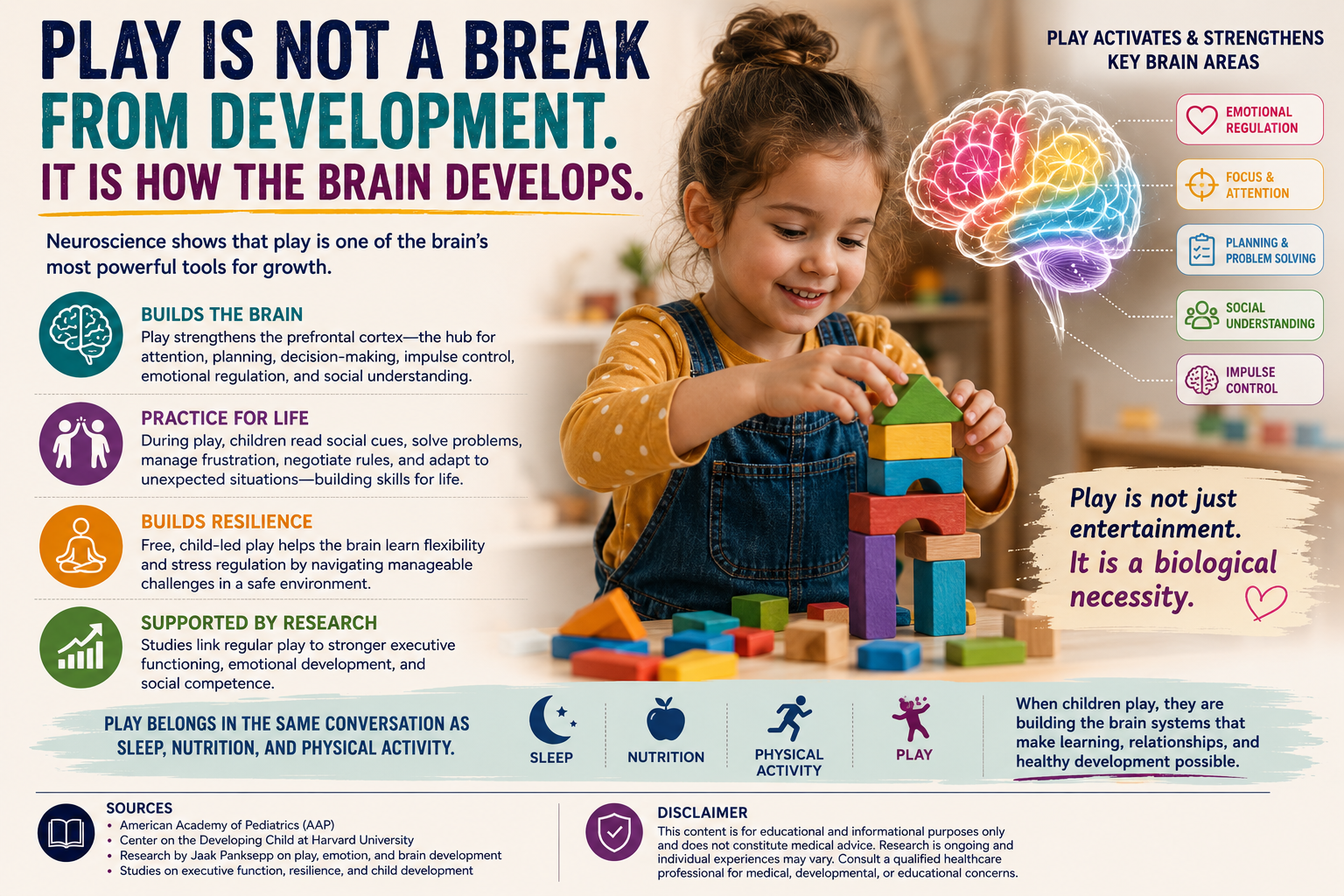
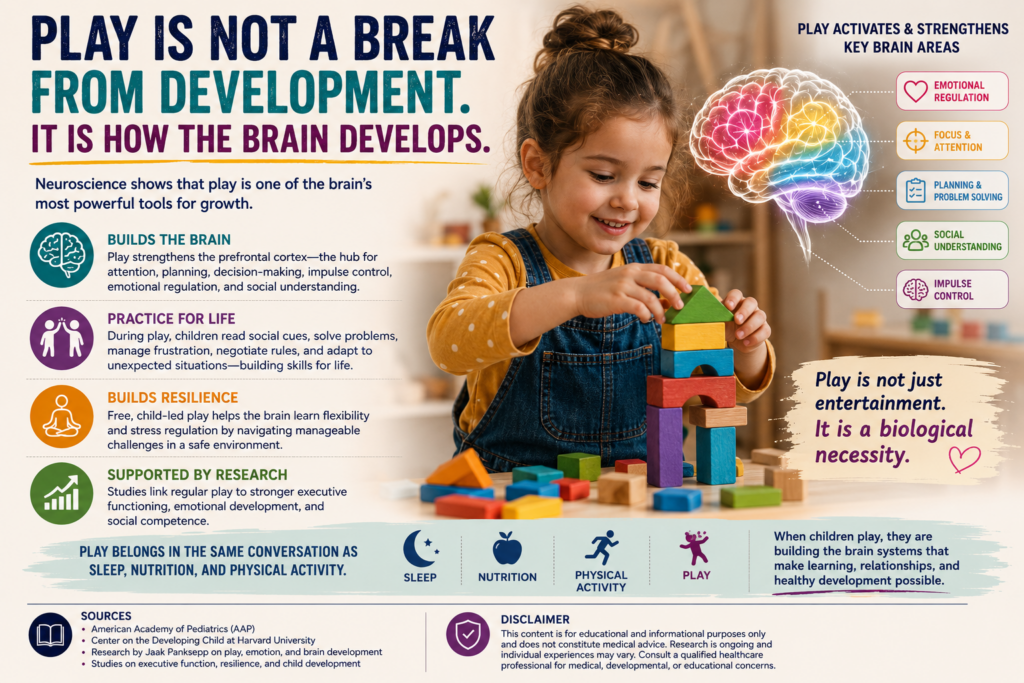
Every time children engage in unstructured, imaginative, or social play, their brains are performing some of their most important work. Far from being idle entertainment, play activates neural systems involved in emotional regulation, attention, decision-making, problem-solving, self-control, and social intelligence.
The prefrontal cortex—the region responsible for planning, impulse control, emotional management, and complex thinking—develops through experience. Play provides exactly the kind of experiences that help strengthen these networks.
When children play, they are constantly:
• Learning to read social cues
• Negotiating rules and boundaries
• Solving unexpected problems
• Managing frustration and disappointment
• Practicing cooperation and empathy
• Adapting to changing situations
In other words, they are rehearsing life.
Play also appears to be one of nature’s most effective resilience-building tools.
Free, child-led play exposes children to manageable challenges within a safe environment. This allows the nervous system to practice flexibility, emotional recovery, and stress regulation without overwhelming pressure. Research suggests that children who engage regularly in play often demonstrate stronger executive functioning, better emotional regulation, and greater social competence.
This is why many developmental experts place play in the same category as sleep, nutrition, and physical activity.
It is not merely recreation.
It is a biological necessity.
Perhaps one of the biggest misunderstandings in modern education is the belief that more instruction automatically creates better learners.
In reality, some of the most important lessons a child will ever learn cannot be taught directly.
They must be played.
When children are playing, they are not stepping away from learning. They are building the very brain systems that make learning, emotional health, healthy relationships, and lifelong success possible.
Sources:
• American Academy of Pediatrics (AAP)
• Center on the Developing Child at Harvard University
• Research by Jaak Panksepp on play, emotion, and brain development
• Studies on executive function, resilience, and child development.
Recommend0 recommendationsPublished in Kelechi Obasi


Subscribe to Awake Events & Posts