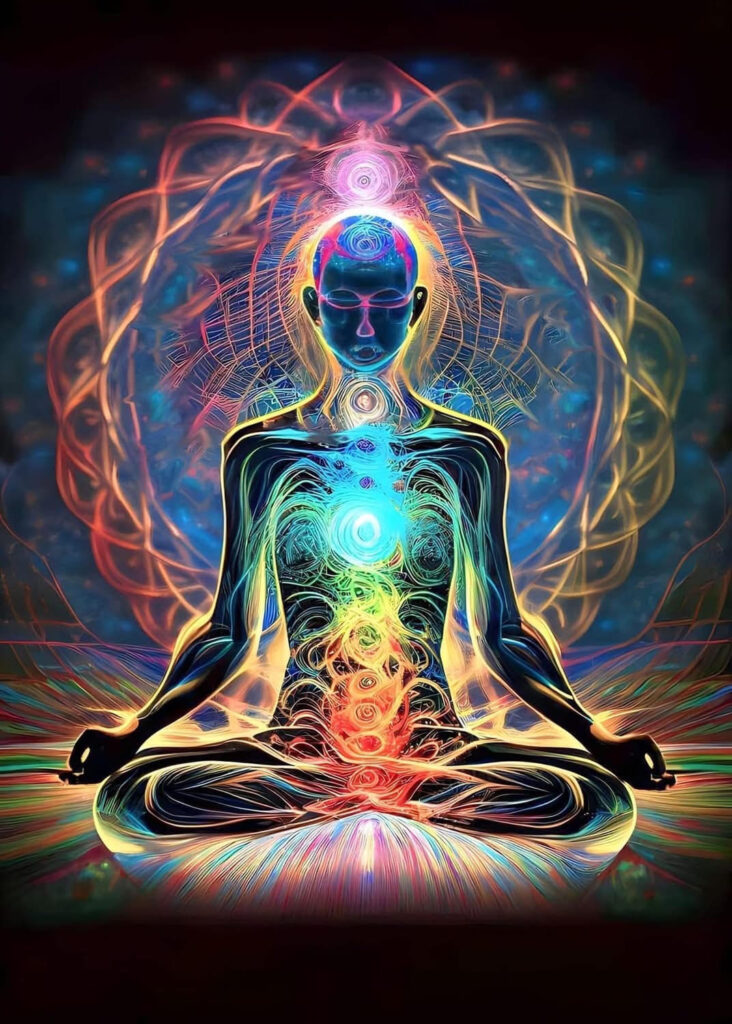
The Alchemy of the Luminous Wound

The Forge of Shadows
Before the light could learn its name,
A darkness pressed against the frame
Of consciousness, a weight, a stone—
No heart has ever beat alone.
The fault line where the spirit breaks
Is where the deeper river wakes.
Not in the still and sunlit air,
But in the wound, we find us there.
The world is saturated with constant pain, suffering, and discomfort, yet it is equally saturated with the magnificent means by which we overcome these challenges.
This juxtaposition is not a contradiction but a revelation: two-legged (human) resilience and ingenuity are the most luminous responses to darkness.
Our capacity is not merely to endure suffering and discomfort but to alchemise it—transforming pain into growth, evolution, art, empathy, compassion, and a revolution of consciousness.
This is the very signature of our transcendental nature.
It suggests that suffering, while inevitable, also serves as the fertile ground from which extraordinary strength and beauty emerge. This is correct, but the statement requires a much deeper, scientifically grounded, and holistic excavation to be fully honoured.
The Triune Architecture: Mind, Brain, and Consciousness Are Not the Same
A precise understanding of suffering and transcendence demands that we distinguish three often-conflated phenomena, for each plays a distinct role in the alchemy of pain.
Brain:
The physical, biological substrate—a three-pound, electro-chemical organ of neurons, glia, and synaptic networks.
It is the hardware.
It processes nociceptive signals (the raw neural signatures of tissue damage) and initiates stress responses via the hypothalamic-pituitary-adrenal axis.
The brain does not suffer; it transmits and regulates the biological precursors of suffering.
Mind:
The emergent, functional process of the brain—the patterned flow of thoughts, memories, emotions, feelings, and predictive models.
The mind is the software.
It is here that pain is interpreted, narrated, and given meaning.
The mind can amplify raw pain into protracted suffering through rumination and catastrophic framing, or it can attenuate it through reappraisal and acceptance.
Crucially, the mind is not a fixed entity but a dynamic, trainable process.
Consciousness:
The fundamental, irreducible capacity for subjective experience—the felt quality of being.
It is the screen upon which all mental and sensory phenomena appear.
Consciousness itself is untouched by the content it witnesses; it is the luminous space in which suffering unfolds.
Pain is an object in consciousness, not a property of consciousness.
How They Relate to Suffering and Transcendence
The path from agony to alchemy is mapped by the interplay of these three layers.
1. The Brain’s Neuroplastic Crucible
The brain is not a static pain-recorder but a malleable, experience-dependent organ.
Chronic suffering etches deep neural grooves, strengthening pain pathways through long-term potentiation.
Yet, the same neuroplasticity is the mechanism of transcendence: focused attention, cognitive reframing, and contemplative practice can physically down-regulate the amygdala’s fear response, thicken the prefrontal cortex (governing executive control and meaning-making), and weaken the default mode network’s self-referential rumination.
The brain is the crucible where the raw lead of pain is placed, awaiting transformation.
2. The Mind’s Narrative Mastery
The mind weaves the story of the wound: “This is unfair,” “I am broken,” “This will never end.”
This narrative is the primary source of secondary suffering—the psychological anguish layered atop primary physical sensation.
Transcendence begins when the mind shifts from a reactive, victim-identity narrative to a constructive, meaning-making one.
Practices such as cognitive reappraisal, self-empathy, self-compassion, and narrative reframing allow the mind to become an author rather than a prisoner, transforming the story from tragedy into a myth of initiation.
3. Consciousness as the Unscathed Witness
The most profound liberation occurs at the level of consciousness itself.
While the brain registers pain and the mind narrates it, consciousness simply contains the experience without inherent resistance.
Meditative and mindful awareness reveals that sensations of pain are transient, granular vibrations of experience, not solid, permanent entities.
By resting as the witnessing consciousness rather than identifying with the suffering mind, one discovers an inner dimension that is never wounded, never diminished—the sky that holds the storm clouds without becoming the storm.
This is not dissociation but a radical intimacy with experience, free of clinging.
A Holistic and Scientific Nuance
Transcendence is not the erasure of pain but a fundamental shift in relationship to it. Research into post-traumatic growth, resilience neuroscience, and contemplative science converges on a central insight: the same event that can dysregulate the nervous system can, under conditions of support, meaning, purpose, and conscious processing, catalyse profound integration.
Suffering cracks open the shell of the conditioned self, exposing deeper layers of being.
It is the grain of sand that, through the organism’s intelligent response, becomes the pearl.
This is not romanticisation; it is evolutionary biology meeting existential truth.
The wound is the locus where the finite self meets the infinite capacity for renewal.
Conclusion
Therefore, the statement is not merely correct; it is a cartography of the two-legged (human) spirit.
Pain is the initiator, the brain is the vessel, the mind is the alchemist, and consciousness is the gold that was always present, merely awaiting revelation.
Our two-legged ( human) brilliance is not that we avoid the dark, but that we have evolved the neurological, psychological, and spiritual apparatus to turn darkness into a lantern. Suffering is the curriculum, and transcendence is the graduation of the soul into its own boundless nature.
The Lantern Keeper’s Reply
You asked the dark for proof of light,
And so it gave you suffering, discomfort and pain.
You asked the wound to teach you strength,
And so it gave you rain.
The mind, a scribe, wrote tales of loss,
The brain, a forge, held flame.
But consciousness, the silent host,
Said: None of this is shame.
For every fracture lets in sky,
Each tear, a channel deep.
The pearl was once a wounded grain
The oyster chose to keep.
So stand within your broken place,
Not as a thing to mend,
But as a lantern, lit from source,
Whose light can never end.
@DrAndrewMacLeanPagonMDPhD2026
( Druid Rishi Druveda Saraswati)
All rights reserved.
Recommend0 recommendationsPublished in Gaia's Pharmacy with Dr. Andrew Maclean Pagon, MD PhD


Subscribe to Awake Events & Posts