What to expect during the ibogaine clinical treatment, Jun 25, Special Guest Thom Leonard

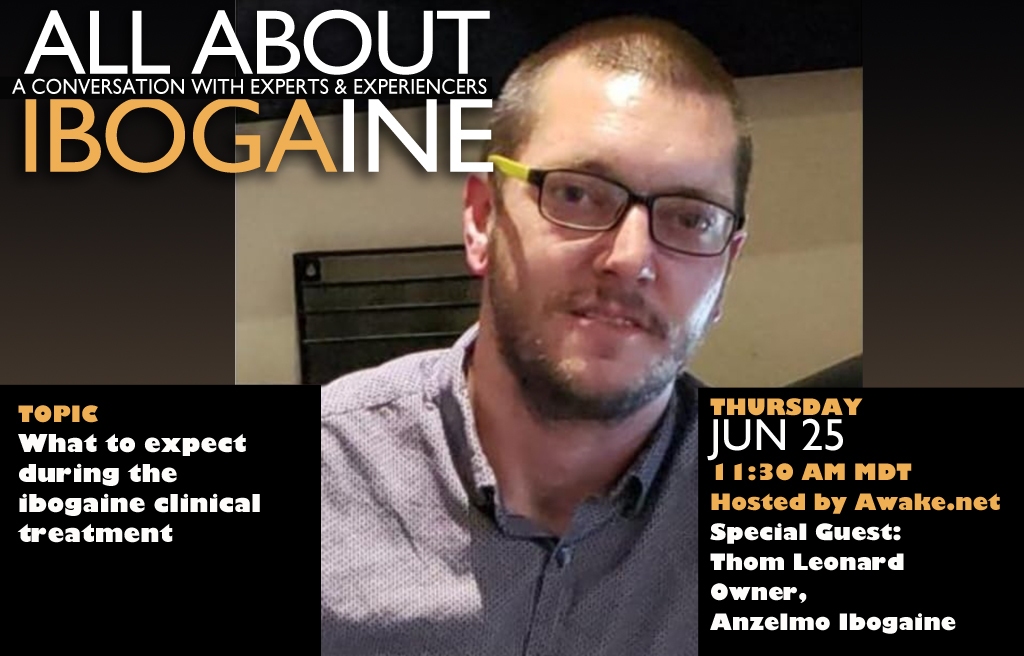
Join us for a conversation with experienced ibogaine provider Thom Leonard about the ibogaine clinical treatment and its intricacies. What to expect and how to show up for it.
THURSDAY, JUN 25
11:30 AM – 1:30 PM MDT
hosted by Awake.net
Special Guest:
Thom Leonard
Founder, Anzelmo Ibogaine
YOUTUBE
Key Takeaways
- Thom Leonard, founder of Anzelmo Ibogaine in Rosarito, Mexico, shared his personal journey from heroin addiction to running an ibogaine treatment clinic.
- Ibogaine HCL can interrupt deadly addictions, often in a single treatment, but requires rigorous medical oversight, pre-screening, and post-treatment support.
- The fentanyl crisis has significantly changed the pre-treatment stabilization process, requiring more extensive detox protocols before ibogaine can be safely administered.
- Patient motivation and honesty are the most critical factors in treatment success; family dynamics can either support or sabotage recovery.
- The psycho-spiritual component of ibogaine is considered essential to its effectiveness — isolating the molecule to remove the altered-state experience is viewed as counterproductive and commercially motivated.
- Realistic success rates are estimated at 65–80% for self-motivated patients and 30–40% for those brought in primarily by family pressure.
- Post-treatment integration, lifestyle change, and letting go of false narratives are as important as the treatment itself.
- Awake.net is developing a nine-month post-ibogaine program called “Change Your Character” to support ongoing recovery.
Discussed Topics
1. Introduction to Ibogaine and the “All About Ibogaine” Podcast
Lakshmi opened the session by introducing the podcast series and its purpose within the Awake Living Library of Mentors and Masters.
- Details
- Lakshmi: Ibogaine is an extract from the plants Tabernanthe iboga and Voacanga africana; ibogaine HCL can interrupt deadly addictions, often in a single clinical treatment lasting approximately one week.
- Lakshmi: Because ibogaine remains a Schedule 1 substance in the United States, providers have operated through medical tourism, primarily in Mexico, where it is unregulated or decriminalized.
- Conclusion
- The podcast aims to archive knowledge from experienced ibogaine practitioners for the benefit of those newly exploring the medicine.
2. Tom Leonard’s Personal Background and Path to Ibogaine
Thom shared his origin story, from early heroin addiction to discovering ibogaine and eventually founding a treatment clinic.
- Details
- thom: Graduated at 16 already addicted to heroin; spent time homeless in subway tunnels before getting clean without ibogaine in his early 20s.
- thom: Remained sober for seven years, during which he first encountered ibogaine through a televised debate featuring Howard Lotsoff.
- thom: Relapsed without a clear inciting incident — his life was stable and he was engaged — but impulsively purchased heroin from a street dealer one day.
- thom: After relapsing, he took a position as a research analyst at the CBOE, which provided cover for drug procurement, allowing him to maintain a functioning lifestyle while addicted.
- thom: Decided to seek ibogaine treatment in Mexico; his mother encouraged him to contact Ibogaine University, where he enrolled in a 30-day program costing approximately $13,000.
- thom: The 30-day program included ibogaine in week one, 5-MeO-DMT in week two, fasting and nutrition in week three, and three ayahuasca ceremonies in week four.
- Conclusion
- Tom’s journey illustrates that relapse can occur even during stable periods, and that ibogaine treatment requires a comprehensive, multi-week approach rather than a quick fix.
3. Transition from Patient to Clinic Operator
Thom described how he moved from being a patient at Ibogaine University to becoming a partner and eventually the sole operator of what is now Anzelmo Ibogaine.
- Details
- thom: After treatment, he relocated to Arizona, worked at an auto body shop, and was later recruited by Scott Ankeny to work at the clinic in Rosarito.
- thom: He began handling phone intake, which he credits as the turning point — his non-salesman, research-encouraging approach rebuilt the clinic’s client base from near-zero to full capacity with a waiting list.
- thom: He became a partner by converting unpaid wages into equity, then bought out co-founder Tyson’s shares using inheritance money from his grandfather, Anzelmo.
- thom: Following Tyson’s unexpected death and a domain name dispute with GoDaddy, he rebranded the clinic as Anzelmo Ibogaine, naming it after his grandfather as a tribute and legacy.
- thom: His grandfather Anzelmo was a first-generation Sicilian-American who served as Tom’s moral compass and primary male role model during a volatile childhood.
- Conclusion
- The clinic’s evolution reflects Tom’s personal growth; the name Anzelmo carries deep personal significance and honors the values instilled by his grandfather.
4. How the Clinic Operates Today — Safety Protocols and Medical Oversight
Thom outlined the current structure of Anzelmo Ibogaine, emphasizing safety, medical oversight, and the impact of the fentanyl crisis on treatment protocols.
- Details
- thom: The treatment team consists of an MD, paramedics, a nurse, and Tom in an administrative and oversight role.
- thom: Paramedics are considered especially critical because their muscle memory is trained for trauma response; premature ventricular contractions are routine for them to manage.
- thom: Only pharmaceutical-grade ibogaine HCL is used, benchmarked at 96% purity but typically testing at 98.2–98.6%; total alkaloid (TA) and BARP extracts are not used.
- thom: Dosing is carefully formulated based on body weight, body mass, lab results, and enzyme levels.
- thom: The fentanyl crisis has dramatically changed pre-treatment protocols; patients who smoke fentanyl may require up to 18 days to test clean, necessitating infusion therapies and accelerated detox methods.
- thom: A protocol exists for adverse cardiac events: patients are transported by ambulance to a hospital in Chula Vista, San Diego, accompanied by the clinic’s paramedic.
- thom: Tom described two adverse cardiac events that were reversed with medication, and one case requiring hospital transfer — the latter involving a patient who had been smuggling alcohol and drugs into the facility.
- Lakshmi: Noted that Tom’s knowledge, while not degree-based, is extensive and earned through years of hands-on clinical experience.
- Conclusion
- Rigorous medical oversight, pharmaceutical-grade materials, and strict pre-screening are non-negotiable safety requirements for flood-dose ibogaine treatment.
- The fentanyl epidemic has made pre-treatment stabilization significantly more complex and time-consuming.
5. Patient Selection, Red Flags, and the Role of Motivation
Tom and Lakshmi discussed what makes an ideal candidate for ibogaine treatment and the warning signs that predict poor outcomes.
- Details
- thom: Honesty — with oneself and with the provider — is the single most important quality in a candidate.
- thom: Red flags include: families making all the phone calls while the patient is unavailable; patients unwilling to engage in pre-treatment coaching; clinics that say “yes” to every special request; and patients seeking only a quick fix.
- thom: Described a case involving a couple where the male patient was not motivated to get clean, repeatedly smuggled drugs into the facility, and became physically aggressive; the female partner, however, demonstrated genuine intention and was treated off-site at a hotel — she remains clean.
- thom: Acknowledged that patients often arrive with drugs on their person on day one; he allows a grace period of two to three days before making judgments, drawing on his own experience of arriving at treatment with heroin.
- Lakshmi: Observed that the inability to come to the phone may also indicate the patient is too physically compromised to withstand treatment.
- thom: Estimated success rates at 65–80% for self-motivated patients versus 30–40% for those primarily driven by family pressure.
- Conclusion
- Patient motivation is the strongest predictor of long-term success; providers who ignore this factor are not serving their clients’ best interests.
- A brief grace period upon arrival is appropriate, but persistent non-compliance after several days warrants discharge.
6. The Role of Family Dynamics in Recovery
The discussion explored how family systems can support or undermine recovery, and how patients must navigate these relationships post-treatment.
- Details
- thom: Addiction is a family disease; family members are often enablers, sometimes more so than they realize.
- thom: Described a case where a patient’s father — himself an alcoholic — was smuggling alcohol into the facility while claiming his son was progressing well.
- Lakshmi: Noted that family members often need to change as much as the patient, drawing on her own experience of leaving India at 23 to escape her family’s fixed projection of her identity.
- thom: Acknowledged that some patients must distance themselves from toxic family systems to maintain recovery, even if that is painful.
- thom: Emphasized that rebuilding family trust requires consistent action over time, not words; cited Apollo’s comment that it took eight years for his sister to trust him.
- Jessie (chat): “Some people’s families will be their downfall every time. They sabotage because they will not adjust their own dynamic.”
- thom: Shared that his own sister disowned him at age 13; they did not reconnect until he was in his mid-30s and now have a close relationship.
- Conclusion
- Family involvement must be carefully managed; enabling behavior by family members can directly endanger patients during treatment.
- Patients cannot control their families’ responses but can control their own boundaries and actions.
7. The Psycho-Spiritual Dimension of Ibogaine
Tom and Lakshmi discussed the transformational and spiritual aspects of ibogaine, and why these cannot be separated from its therapeutic efficacy.
- Details
- thom: Described ibogaine as a “forced white light experience” that works on multiple levels simultaneously — neurological restoration, introspective confrontation of suppressed truths, and a shift in self-perception.
- thom: The psychedelic component is “tantamount to its success”; removing it to create a patentable maintenance medication would not serve patients and is commercially motivated.
- thom: Addiction at its core is a “spiritual malady” — an attempt to fill a “God-sized hole” that no substance can fill.
- thom: Described his own experience as resembling an animated version of the Book of the Dead; it led him from militant atheism to identifying as a spiritual person.
- thom: The most concise summary of why ibogaine worked for him: “I was able to say I love myself and mean it.”
- Lakshmi: Framed the spiritual experience as energetic rather than strictly religious; noted that all major religions converge on the same truth at their core.
- Jessie (chat): “It’s about not being the center of the universe — which many of us are in active addiction. Doesn’t require religion itself, but for sure humility and spirituality.”
- Apollo (chat): “5-MeO DMT — the cherry on top after ibogaine. Self-love / pure love.”
- Conclusion
- The altered-state experience is integral to ibogaine’s effectiveness for addiction and mental health conditions; efforts to isolate the molecule and remove this component are viewed as commercially driven and therapeutically counterproductive.
8. Post-Treatment Integration — Letting Go of False Narratives and Rebuilding Authenticity
Tom elaborated on the work required after ibogaine treatment to sustain recovery.
- Details
- thom: Ibogaine restores neuroplasticity and opens atrophied neural networks, but patients must consciously choose not to revert to old thought loops and dishonest patterns.
- thom: Patients must commit to releasing false narratives — not necessarily confessing everything, but at minimum stopping the active maintenance of lies.
- thom: Described his own relapse during a mandatory court return to Chicago as part of his journey; the experience was physically aversive and reinforced his commitment to sobriety.
- thom: Cautioned against sharing relapse stories with clients in a way that could be interpreted as a “hall pass” to use one more time.
- Lakshmi: Drew a parallel to her own experience with smoking cessation via psilocybin, noting that a future-oriented “permission narrative” is itself a form of ongoing temptation that must be consciously dismantled.
- thom: Emphasized that only the individual can initiate their own journey; support systems exist, but the first step must come from within.
- Conclusion
- Post-treatment integration is as critical as the treatment itself; authentic self-examination, boundary-setting, and consistent action are the foundations of lasting recovery.
9. Awake.net’s “Change Your Character” Program and Community Resources
Lakshmi introduced Awake.net’s upcoming post-ibogaine integration program.
- Details
- Lakshmi: Awake.net is a social network aggregating mentors and masters from the ibogaine and broader entheogenic community.
- Lakshmi: A nine-month post-ibogaine course called “Change Your Character” is in development, taught by multiple teachers across different modalities; launch is forthcoming.
- Lakshmi: Invited ibogaine and entheogenic providers with significant experience to join the Awake.net directory of mentors and masters.
- Conclusion
- Awake.net aims to provide structured, community-based post-treatment support to complement clinical ibogaine treatment.
Challenges
- Fentanyl contamination of the drug supply has made pre-treatment stabilization far more complex, requiring extensive detox protocols and delaying treatment timelines significantly.
- Patient dishonesty and drug smuggling during treatment remain persistent risks that cannot be entirely eliminated through screening alone.
- Family enabling behavior can directly undermine treatment safety and outcomes, and is difficult to fully control or predict.
- Unrealistic success rate claims by some providers (cited as 80–90%) create false expectations; realistic rates are considerably lower and depend heavily on patient motivation.
- Efforts to isolate the ibogaine molecule and remove its psychedelic component for pharmaceutical patenting are seen as a systemic threat to the medicine’s therapeutic integrity.
- Operational demands — 24/7 availability, managing intake calls across global time zones, and maintaining treatment quality — place extreme personal burden on clinic operators.
- Domain and intellectual property vulnerabilities were highlighted by the loss of the Ibogaine Institute website following a co-founder’s unexpected death.
Recommend0 recommendationsPublished in Daily Dose, EVENTS, Gaia's Pharmacy with Dr. Andrew Maclean Pagon, MD PhD



Subscribe to Awake Events & Posts