
Appropriation vs Appreciation with special guest Jeremy Weate, All About Ibogaine, Jul 30, Replay

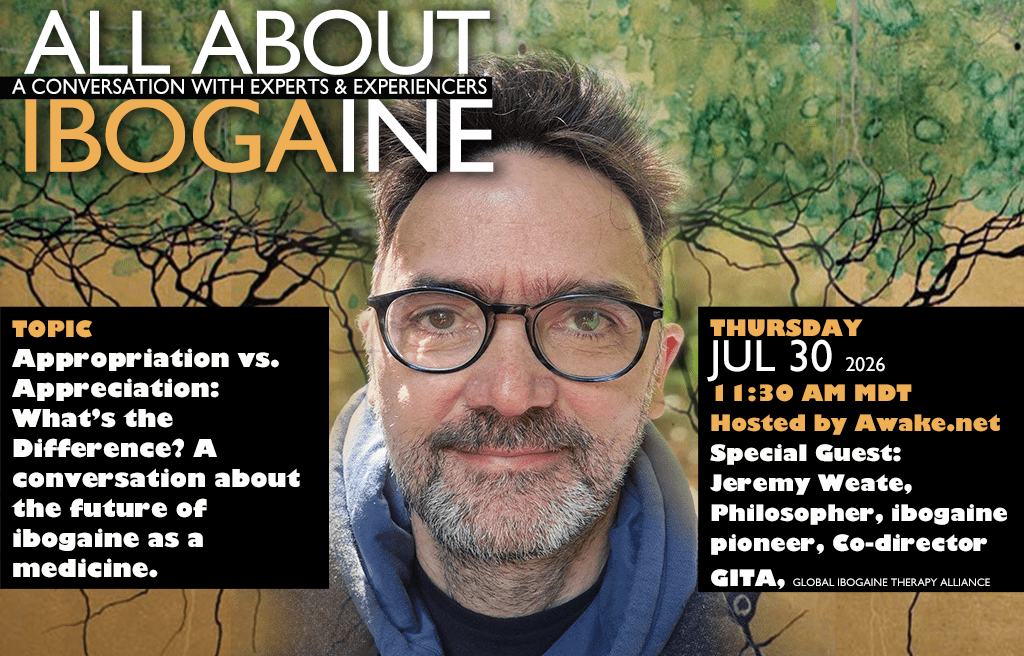
A nuanced conversation with Jeremy Weate, ibogaine pioneer, philosopher, and co-director of GITA (Global Ibogaine Therapy Alliance) about the socio-political-economic forces shaping the future of ibogaine and other sacraments as they enter the global medical marketplace.
Original Event: Thursday July 30, 2026
Key Takeaways
- The meeting was a recorded episode of “All About Ibogaine,” a Thursday conversation series hosted by Lakshmi Narayan on awake.net, featuring special guest Jeremy Wheat, a long-time Ibogaine pioneer and co-director of GITA (Global Ibogaine Therapy Alliance).
- Jeremy shared his personal origin story with Iboga, including a three-week Bwiti initiation in Gabon, and emphasized the importance of humility and embodied knowledge over intellectual understanding.
- The conversation explored the socio-political and economic factors shaping how Ibogaine is perceived and used as it enters the global stage.
- Concerns were raised about the commercialization and medicalization of Ibogaine, particularly the “evangelical” American model that oversimplifies the medicine’s transformative potential.
- The topic of cultural appropriation versus appreciation was discussed at length, with both speakers agreeing that cultures are inherently hybrid, while also acknowledging the real pain of colonial history and the importance of reciprocity.
- Eli Lilly’s $2.8 billion acquisition of a 5-MeO-DMT company was discussed, with concerns raised about pharmaceutical reduction of psychedelic medicines.
- The group emphasized the need for reverence, proper preparation, aftercare, and community support in Ibogaine treatment.
- Structural economic inequalities preventing places like Gabon and Malawi from benefiting from their own natural resources were highlighted as a core justice issue.
Discussed Topics
1. Introduction of Jeremy Wheat and the Purpose of the Podcast
Lakshmi formally opened the recorded session and introduced Jeremy Wheat.
- Details
- Lakshmi: Explained the podcast was launched following Trump’s announcement about fast-tracking Ibogaine, to provide a platform for experienced pioneers and to educate newcomers.
- Lakshmi: Introduced Jeremy as a philosopher, long-time Ibogaine pioneer, former co-runner of Tabula Rasa, and co-director of GITA.
- Lakshmi: Framed the session’s focus as a deep dive into the socio-political and economic factors influencing Ibogaine’s global emergence.
- Conclusion
- The podcast serves as a counterculture voice to the commercial narrative around Ibogaine.
- The session’s central theme is “Appropriation versus Appreciation.”
2. Jeremy Wheat’s Personal Origin Story with Iboga
Jeremy described how he first encountered Iboga and what led him to his Bwiti initiation in Gabon.
- Details
- Jeremy: First heard about Iboga approximately 23–24 years ago while living in Nigeria and immersed in Yoruba culture; a friend mentioned it on a London bus.
- Jeremy: Was drawn to Iboga partly out of frustration with negative Western stereotypes of African cultures.
- Jeremy: Traveled to Gabon for a Bwiti initiation at Ibando, a compound on the outskirts of Libreville run by a widely respected French man who settled in Gabon after his truck broke down in the 1970s.
- Jeremy: Described the initiation as a three-week ordeal involving forest baptism, smoking ceremonies, a full flood dose of Iboga root bark, and all-night dancing sessions.
- Jeremy: The Nima (shaman) overseeing his ceremony cautioned that Bwiti knowledge is not book knowledge but knowledge of the body, requiring long apprenticeship.
- Jeremy: Emphasized that the most profound aspects of the Iboga experience operate below conscious awareness, refreshing the central nervous system rather than simply producing visions.
- Conclusion
- Jeremy’s calling to Ibogaine is not rational but deeply somatic and experiential.
- He maintains humility about his limited knowledge of Bwiti and plans to return to Gabon slowly and deliberately.
5. The Nature of Knowledge, Consciousness, and Iboga’s Metaphysical Dimensions
Jeremy and Lakshmi explored philosophical questions about the limits of human understanding and the nature of Iboga’s effects.
- Details
- Jeremy: Referenced Terence McKenna’s view that humans have very little understanding of what is really happening, even with advanced theoretical physics only reaching the edge of full reality at the quantum level.
- Jeremy: Suggested that Iboga may be pointing to a reality too vast for the human brain to fully comprehend, likening the experience to Plato’s cave.
- Lakshmi: Affirmed the concept of beginner’s mind and noted that human knowledge spans continents and time, with profound wisdom found across cultures.
- Lakshmi: Argued that human consciousness is universal and that the archetypal spiritual journey is accessible through many medicines and traditions, not exclusively Iboga.
- Conclusion
- Both speakers agreed that intellectual humility is essential when approaching Iboga and Bwiti.
- The full reality that Iboga points to may exceed human cognitive capacity.
6. Bwiti as a Discipline and the Question of Cultural Ownership
Jeremy addressed whether Bwiti traditions claim exclusive access to spiritual truth and how to understand their knowledge systems.
- Details
- Jeremy: Emphasized he cannot speak with authority for the internally diverse and evolving Bwiti traditions.
- Jeremy: Described Bwiti as a disciplinary system requiring many years of apprenticeship, similar to becoming a Buddhist or Christian monk — a slow, somatic gathering of knowledge.
- Jeremy: Noted that from his perspective, Gabonese people demonstrate openness rather than territorialism, and would want to share their gifts with the world.
- Jeremy: Distinguished between claims of cultural superiority and claims of disciplinary depth — the latter being legitimate and deserving of respect.
- Jeremy: Highlighted that Gabon’s forest-dwelling, non-agricultural tradition produces a fundamentally different metaphysics and sense of time compared to Western agricultural societies.
- Lakshmi: Agreed that no single tribe can claim exclusive knowledge, and that awakening is a universal, ongoing evolution of consciousness.
- Conclusion
- Bwiti knowledge is not a claim of superiority but a body of disciplinary, embodied wisdom built over generations.
- Respect for this tradition requires presence, time, and genuine engagement — not intellectual shortcuts.
7. Gabon’s Colonial History and Its Relationship to France
Jeremy provided historical context on France’s extractive relationship with Gabon.
- Details
- Jeremy: Described Gabon as having been a vassal client state of France, with Gabonese oil funding French politics for decades and Paris effectively choosing Gabon’s presidents.
- Jeremy: Noted that Gabon is only now, following a recent change in administration, beginning to throw off French influence.
- Jeremy: Drew a parallel between French colonialism in Gabon and Belgian atrocities in the DRC, arguing that colonial trauma cannot be dismissed when discussing cultural exchange.
- Jeremy: Explained that the Bantu people migrated into Gabon relatively recently (100–200 years ago), largely in the context of colonialism and slave raids from West Africa, while the Pygmies are the original long-term forest dwellers.
- Conclusion
- Gabon’s post-colonial status is fragile and recent; its colonial history is inseparable from discussions of Iboga and reciprocity.
- The original custodians of Iboga knowledge are the forest-dwelling Pygmy peoples, not the more recently arrived Bantu populations.
8. The Archetypal Healing Experience of Ibogaine
Jeremy described the core therapeutic mechanism of Ibogaine through a personal anecdote.
- Details
- Jeremy: Recounted a story of a business contact who, after an Ibogaine experience in Costa Rica, spent two days making amends by phone after gaining radical compassion — seeing traumatic childhood events from the other person’s perspective simultaneously.
- Jeremy: Described this as the archetypal Ibogaine experience: the ability to hold one’s own emotional perspective and another’s simultaneously, dissolving victimhood and enabling forgiveness.
- Jeremy: Connected this to its relevance for veterans and PTSD treatment.
- Lakshmi: Noted that similar experiences can occur through other modalities such as the Landmark Forum, affirming the universality of the healing mechanism.
- Jeremy: Agreed that Ibogaine’s healing is universal — not exclusively tied to Bwiti or Gabon — but emphasized its unique depth and power.
- Conclusion
- The core healing gift of Ibogaine is a universal unlock of embedded, emotionally encoded memories, enabling radical compassion and liberation from victimhood.
- This mechanism is what makes Ibogaine particularly relevant for addiction and trauma treatment.
9. Jeremy’s Clinical Experience at Tabula Rasa and Concerns About Commercialization
Jeremy reflected on his time working at an Ibogaine clinic in Portugal and his concerns about reductive commercial models.
- Details
- Jeremy: In 2016, co-founded an Ibogaine clinic in southern Portugal with Alvaro, initially intending to handle the business side but ended up sitting for patients and monitoring EKGs.
- Jeremy: Witnessed the miracle of people emerging from deep addiction within hours, describing it as a profound privilege.
- Jeremy: Warned that the “American evangelical” model sets unrealistic expectations — presenting Ibogaine as a complete cure rather than the beginning of a difficult journey.
- Jeremy: Emphasized that aftercare, integration, and community support are essential, and that relapse is normal.
- Jeremy: Expressed concern that dependency patterns often morph rather than fully disappear, requiring ongoing work down to a mitochondrial level.
- Jeremy: Acknowledged being “smacked around the head” by attempts to commercialize Ibogaine and has since returned to his consulting work.
- Conclusion
- Ibogaine treatment requires robust preparation, aftercare, and integration support — not a transactional, drive-through model.
- The “miracle” of Ibogaine is real but is only the beginning of a longer healing journey.
10. Veterans Pathway Initiative
Jeremy briefly described current work with Anders on a veterans-focused Ibogaine program.
- Details
- Jeremy: Working with Anders at early stages to develop a veterans pathway grounded in a UK/European and Five Eyes (including Australian and New Zealand) perspective.
- Jeremy: The program is intended to be veteran-led and inspired by American veteran advocacy for psychedelics and Ibogaine specifically.
- Jeremy: Praised the quality of American veteran advocacy while cautioning against the “drive-through Ibogaine” model of 48-hour Mexico trips.
- Conclusion
- A veteran-led, culturally appropriate Ibogaine pathway is in early development for the UK/European context.
- Strong advocacy has been valuable but must not be conflated with appropriate clinical models.
11. Eli Lilly’s $2.8 Billion Acquisition of 5-MeO-DMT and Pharmaceutical Reduction of Psychedelics
Lakshmi, Jeremy, and Garyth discussed the implications of Eli Lilly’s acquisition and the broader trend of pharmaceutical companies reducing psychedelic medicines.
- Details
- Lakshmi: Noted that Eli Lilly’s version reportedly removes the “rocket ship effect” from 5-MeO-DMT, raising the question of what remains therapeutically.
- Garyth: Expressed ambivalence — believing the molecule should be shared with humanity but concerned about the nasal spray model requiring office visits every three months, reducing it to an antidepressant.
- Garyth: Described 5-MeO-DMT as potentially one of the most important experiences a human being can have — not merely a drug experience.
- Jeremy: Acknowledged a personal conflict of interest, holding stock in Atai (acquired by Eli Lilly), but expressed skepticism about the pharmaceutical model.
- Lakshmi: Drew a parallel to SSRIs, which were derived from plant medicine traditions and have contributed to a mental health emergency due to imperfect research and profit-driven development.
- Jeremy: Noted the contradiction between his view that somatic effects matter more than conscious experience and the concern that removing the experiential component debases the medicine.
- Conclusion
- Pharmaceutical reduction of psychedelic medicines risks repeating the failures of SSRIs.
- The experiential and alchemical dimensions of these medicines are inseparable from their therapeutic value.
- A hybrid future — combining medicalized access with cottage/boutique models — is likely and potentially desirable.
12. Cultural Appropriation versus Appreciation
The central thematic discussion of the session, exploring whether cultural appropriation is a meaningful concept in the context of Ibogaine.
- Details
- Lakshmi: Argued that cultural appropriation is a false and divisive concept, noting that all culture originated in Africa and that human cultures have always exchanged knowledge across continents. She framed the concept as a politically introduced meme that divides rather than unites.
- Lakshmi: Distinguished between genuine reciprocity (coming from the heart) and imposed tribute demands, arguing that plants do not belong to anyone.
- Jeremy: Agreed that cultural essentialism is incoherent — cultures are inherently hybrid and never static. Used the example of Japan’s apparent cultural monolith concealing Ainu indigenous history and Chinese Buddhist influences.
- Jeremy: Introduced the counterpoint that colonial and post-colonial trauma is real and cannot be dismissed; the pain of extractive colonial history is embedded in generations and must be acknowledged.
- Jeremy: Used the example of the Yoruba figure Eshu being translated as Satan in the 19th-century Yoruba Bible, describing it as a “dagger to the spiritual heart” of Yoruba culture — a form of cultural destruction with no parallel in the Indian experience.
- Rachel in PA: Added a historian’s perspective, cautioning against overgeneralization about Africa given its enormous size and diversity, and emphasizing the importance of reverence and humility, drawing on her experience with Native American church traditions.
- Lakshmi: Clarified she is not advocating for raiding or hacking traditions, but for people to discern genuine knowledge keepers from commercial opportunists.
- Jeremy: Framed reciprocity not as financial transaction but as a human response to structural inequality — wanting to help Gabonese people empower themselves economically.
- Conclusion
- Cultural essentialism and the concept of cultural appropriation as commonly deployed are intellectually incoherent, as all cultures are hybrid.
- However, colonial trauma is real and must be acknowledged; reciprocity should be understood as genuine partnership and economic empowerment, not mere financial tribute.
- Reverence, humility, and long-term relationship are the appropriate foundations for engaging with Iboga traditions.
13. Structural Economic Inequality and Ibogaine Access
Jeremy and Lakshmi discussed the systemic barriers preventing source communities from benefiting from their natural resources.
- Details
- Jeremy: Used Malawi Gold cannabis as an example — Malawi has one of the world’s best cannabis strains but cannot leverage it economically due to lack of investment capital, high interest rates (15–20%), and exclusion from global financial networks.
- Jeremy: Argued that places like Gabon should be leading botanical research on Tabernanthe iboga and Tabernanthe elliptica, in genuine partnership with Western institutions rather than being bypassed.
- Lakshmi: Attributed the problem to profit-driven business culture, where investor demands for high margins (60–200%) structurally prevent equitable arrangements.
- Rachel in PA: Added that conservatives can be motivated by cost-saving arguments — Ibogaine treatment is economically efficient compared to conventional rehabilitation — and suggested an economic reinvestment framing could build broader coalitions.
- Jeremy: Emphasized that the structural unfairness is manufactured, not inherent to the people or places involved.
- Conclusion
- Source communities are systematically excluded from the economic value of their natural resources due to structural financial barriers.
- Reciprocity must include capacity-building, research partnerships, and economic empowerment in places like Gabon.
- An economic efficiency argument for Ibogaine may help build conservative political support.
14. Oregon Psilocybin Model and the Risk of Elitism in Psychedelic Access
Jeremy referenced recent critiques of state-sanctioned psychedelic provision.
- Details
- Jeremy: Cited Paul Austin (founder of Third Wave) on how Oregon’s psilocybin provision has become elitist and predominantly white, with rising licensing costs making it increasingly inaccessible.
- Jeremy: Referenced an unnamed former psychedelic investor who publicly walked away from the sector, expressing disgust at the “toxic ego phrenia” he witnessed.
- Jeremy: Warned that the American healthcare system’s profit orientation will produce a two-tier Ibogaine market — luxury treatment versus bargain basement options.
- Jeremy: Expressed hope that Mexico will remain a viable, higher-quality alternative to American medicalized Ibogaine, given lower costs and a more conducive environment for holistic treatment.
- Conclusion
- State-sanctioned psychedelic models risk becoming elitist and inaccessible to those who need them most.
- Mexico-based cottage/boutique clinics may offer superior treatment quality and accessibility compared to American medicalized models.
- The amplifier effect of psychedelics can surface unresolved cultural shadows as well as individual ones.
15. Tribute to Dana Beale and Paul Featherstone
Jeremy acknowledged two foundational figures in the Ibogaine movement.
- Details
- Jeremy: Described Paul Featherstone as a hidden figure and “the man behind the curtain” of the Ibogaine movement, who spent hours guiding Jeremy in his early years and deserves far more recognition.
- Jeremy: Recounted being taken by Dana Beale to an ACT UP meeting in New York on his first visit, describing Dana as an “angel” who funded the Ibogaine movement through unconventional means.
- Lakshmi: Noted that Dana Beale should not be facing a nine-year prison sentence and that a signature campaign is being organized.
- Conclusion
- Paul Featherstone and Dana Beale are recognized as foundational, underacknowledged contributors to the Ibogaine movement.
- Support for Dana Beale’s legal situation is being mobilized.
16. The Role of Community, Integration, and Institutional Knowledge
Jeremy and Lakshmi discussed what is missing in Western psychedelic culture and what healthy containers look like.
- Details
- Jeremy: Argued that Western society lacks the layers of community and communitas needed to support people after an Ibogaine experience.
- Jeremy: Used the Buddhist Sangha model as an example of a healthy institutional container — a community of elders providing accountability, support, and gradual spiritual development.
- Jeremy: Warned that psychedelics transplanted onto the “barren ground” of Western anomie, without structures of accountability, enable ego inflation and abuse by self-appointed gurus.
- Lakshmi: Agreed, framing awake.net as a counterculture community creating new paradigms for psychedelic healing, emphasizing the “inner shaman” and lifelong integration.
- Jeremy: Distinguished between the legitimate role of political advocates (who are no longer needed once critical mass is reached) and the practitioners who do the ongoing work of service to the medicine.
- Conclusion
- Healthy psychedelic healing requires community, elder systems, horizontal accountability, and long-term integration support.
- Institutions, when functioning well, are essential conduits for spiritual evolution — but must be protected from corruption and ego inflation.
- The cottage/boutique model, exemplified by practitioners like Garyth, offers a more appropriate container than factory-scale or purely medicalized approaches.
Challenges
- Legal and structural barriers for 501(c)(3) organizations: awake.net cannot directly fund Schedule 1 substance treatment without risking loss of nonprofit status; restructuring is required and ongoing.
- Commercialization and reductive medicalization of Ibogaine: The pharmaceutical and evangelical American models risk oversimplifying and debasing the medicine, setting unrealistic expectations and undermining genuine healing.
- Lack of Gabonese and Indigenous voices: The Ibogaine conversation is dominated by Western interpreters; authentic Gabonese voices (particularly forest-dwelling communities) are largely absent from global discourse.
- Structural economic exclusion of source communities: Places like Gabon and Malawi cannot leverage their natural resources for economic empowerment due to lack of investment capital, high interest rates, and exclusion from global financial networks.
- Elitism and inaccessibility in state-sanctioned psychedelic models: Oregon’s psilocybin model is becoming prohibitively expensive and demographically narrow; similar risks exist for Ibogaine medicalization in the US.
- Absence of community and integration infrastructure: Western society lacks the communal structures needed to support people through and after Ibogaine experiences, increasing the risk of relapse and psychological harm.
- Dana Beale’s legal situation: A foundational figure in the Ibogaine movement is facing a nine-year prison sentence, which participants consider unjust.
- Stacking of psychedelic substances: Growing trend of combining multiple substances without adequate research on interactions or comorbidities poses safety risks.
Recommend0 recommendationsPublished in All About Ibogaine



Subscribe to Awake Events & Posts


Responses