Forgiveness and Letting Go with special guest Ana Holub, All About Ibogaine Jul 16

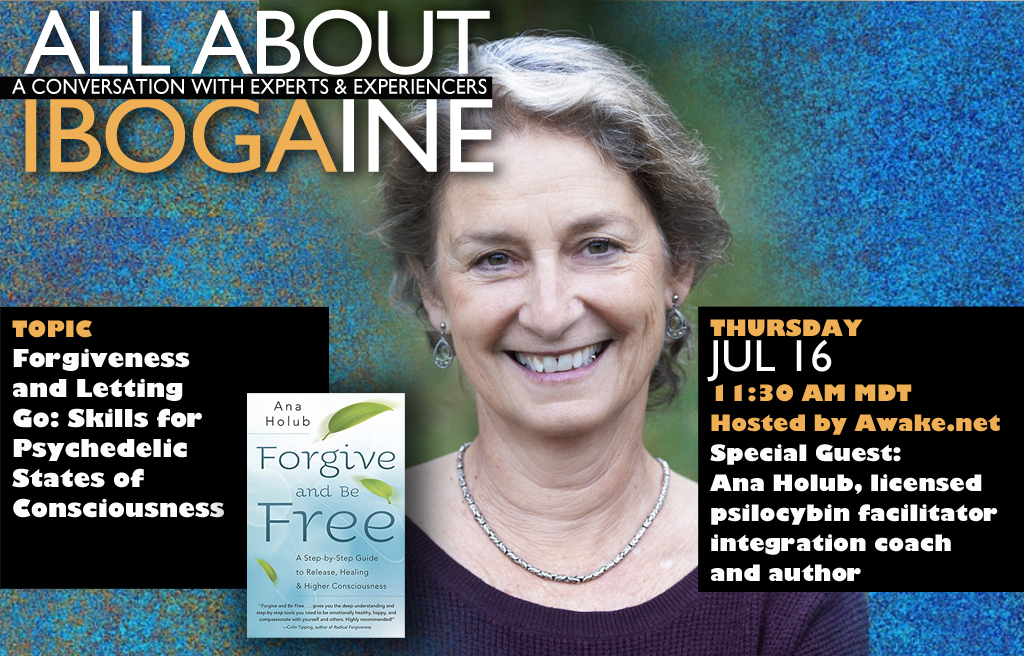
REPLAY a deep dive into the world of Ana Holub, author, integration coach and licensed psilocybin facilitator, as we explore the role of forgiveness and letting go as vital skills in the journey of healing and awakening activated by psychedelics.
https://youtu.be/WIwLL8fnGlI
Key Takeaways
- Ana Holub shared her personal journey from early psychedelic experiences to becoming a licensed psilocybin facilitator and forgiveness coach in Oregon.
- Forgiveness is framed not as a passive or religious act, but as an active, skill-based process involving honesty, humbleness, willingness, and surrender.
- Ibogaine was described as a powerful “forgiveness medicine,” particularly effective for addiction recovery by facilitating deep compassion and self-forgiveness.
- Integration after psychedelic journeys is essential and should include honest communication, skill-building, and ongoing inner work — not a one-time event.
- Solo psychedelic journeys can be valid for personal growth, but ibogaine specifically should never be done alone due to serious safety risks.
- Forgiveness does not require an apology from the person who caused harm; the process is internal and empowers the individual regardless of external circumstances.
- The SafeNest project, co-created by Ana Holub and her husband, offers conscious psychedelic journeying support for couples and small groups.
- Awake.net was discussed as a community platform for experienced psychedelic practitioners, elders, and integration specialists.
Discussed Topics
1. Introduction and Background of Ana Holub
Lakshmi introduced Ana Holub as a psychedelic integration coach, licensed psilocybin facilitator, and author of “Forgive and Be Free.” The two reconnected after meeting years ago at a psychedelic community gathering.
- Details
- Lakshmi: Described Ana as someone with deep roots in the psychedelic community, noting her work at Being True to You and her focus on forgiveness as a healing modality.
- Ana: Expressed gratitude for the reconnection and acknowledged the shared history within the psychedelic healing community.
- Conclusion
- Ana Holub brings over 25 years of experience in forgiveness work, psychedelic facilitation, and integration coaching.
2. Ana Holub’s Personal Origin Story
Ana described her early life, including her introduction to psychedelics in high school and college, her mother’s suicide three weeks before she gave birth, and her path toward healing through meditation, yoga, and forgiveness work.
- Details
- Ana: Began experimenting with LSD in high school and discovered psilocybin mushrooms at UC Santa Cruz, initially without context or support, which led to cycles of highs and depression.
- Ana: Stopped psychedelics and turned to meditation and yoga to build inner stability before returning to plant medicines later in life.
- Ana: Shared that her mother died by suicide when Ana was 23 and eight months pregnant, describing it as devastating and a profound spiritual challenge.
- Ana: Explained that she studied peace education because she personally needed it, and that this led her to forgiveness work.
- Ana: Discovered the book “Radical Forgiveness” by Colin Tipping, studied with him, became a certified coach, and eventually developed her own complementary forgiveness methodology.
- Conclusion
- Ana’s personal trauma — including her mother’s suicide and single parenthood — became the foundation for her forgiveness practice.
- Her approach diverges from traditional forgiveness models by emphasizing honesty, emotional release, devotion, and receiving intuitive wisdom.
3. Ana’s Forgiveness Methodology
Ana described her forgiveness process in detail, distinguishing it from conventional or religious notions of forgiveness.
- Details
- Ana: Forgiveness is not about making nice or pretending things were fine — it requires full honesty about pain, resentment, disappointment, and anger.
- Ana: The process involves prayer or intention, humbleness, sitting with emotions, making an offering to spirit or the oneness, and then receiving wisdom.
- Ana: Described forgiveness as a lifelong “workout” that builds inner muscle over time, not a one-time event.
- Ana: Emphasized that receiving wisdom after releasing pain is equally important as the letting go itself.
- Lakshmi: Noted that forgiveness is essentially a form of surrender and a frequency shift.
- Ana: Confirmed that surrender and forgiveness are deeply linked, and that both are loaded words for many people.
- Ana: Clarified that her work is not spiritual bypassing — it acknowledges real harm and does not ask people to cover over what is genuinely wrong.
- Conclusion
- Forgiveness is an internal, skill-based process that does not depend on receiving an apology or acknowledgment from the person who caused harm.
- The process begins with humbleness and prayer/intention, moves through honest emotional acknowledgment, and culminates in release and receiving.
4. The Role of Psychedelics in Forgiveness and Healing
Ana and Lakshmi discussed how psychedelic medicines, particularly psilocybin and ibogaine, intersect with forgiveness work and trauma healing.
- Details
- Ana: Returned to psychedelics in her 40s with a more grounded foundation, conducting solo psilocybin journeys that deepened her forgiveness practice.
- Ana: Found that her forgiveness skills allowed her to move through difficult material in journeys without panicking, trusting the process and letting things flow.
- Lakshmi: Shared her own ayahuasca experience in which she encountered a traumatic childhood memory and was guided to forgive in order to physically and emotionally release.
- Ana: Noted that physical releases — such as urination or crying — are common during forgiveness sessions, reflecting the body’s role in holding emotional pain.
- Ana: Described how forgiveness work and psychedelics are complementary: forgiveness prepares the inner space, and psychedelics can deepen and accelerate the process.
- Lakshmi: Described the threshold moment in psychedelic journeys where panic can spiral or trust can redirect the experience.
- Ana: Agreed that trust — knowing where to place attention when not panicking — is central to navigating difficult psychedelic states.
- Conclusion
- Forgiveness work and psychedelic journeys are mutually reinforcing practices.
- Having a forgiveness foundation before entering psychedelic states allows for deeper, more fluid processing of difficult material.
5. Ana’s Ibogaine Experience
Ana described her personal ibogaine journey in Mexico, which she undertook to understand the medicine firsthand after hearing about its effectiveness for addiction recovery.
- Details
- Ana: Went to Mexico for an ibogaine experience after clients at Being True to You were using it for addiction recovery and she wanted direct knowledge of the medicine.
- Ana: Described ibogaine as a “forgiveness medicine” that works on addiction by facilitating deep compassion and release.
- Ana: Her journey began with a vision of her parents’ conception of her, allowing her to witness their grief over a deceased son and feel compassion for the emotional environment she was born into.
- Ana: Progressed through personal forgiveness themes — including a self-forgiveness moment with her deceased mother — and then moved into global-scale visions of humanity’s darkness.
- Ana: Described the journey as linear, moving from personal to ancestral to global, and eventually arriving at a place of unity and peace with the Divine Mother, Divine Father, and oneness.
- Ana: Compared the exhaustion of the 12-hour ibogaine journey to labor during childbirth — a natural process that cannot be stopped and requires surrender.
- Lakshmi: Affirmed that reserves emerge when the medicine demands more, similar to a marathon or long hike.
- Conclusion
- Ibogaine facilitates a structured, often linear forgiveness process that moves from personal to ancestral to universal.
- The experience is physically and emotionally demanding and requires trust, willingness, and prior inner work to navigate effectively.
- Ana added the ibogaine story to the second edition of her book “Forgive and Be Free.”
6. Integration After Psychedelic Journeys
Ana and Lakshmi discussed the importance of integration and how forgiveness work supports the process of bringing insights from journeys into daily life.
- Details
- Ana: Described integration as the living application of what was revealed during a journey — including having honest conversations with people in one’s life.
- Ana: Shared an example of a client who, on the way down from a psilocybin journey, expressed anger about a family member; the integration session the next day focused on what action she needed to take.
- Ana: Noted that integration sometimes requires direct communication with others, but always with the momentum of blame worked out first through forgiveness.
- Lakshmi: Described integration as becoming the person who can hold the elevated energy experienced during a journey in everyday life.
- Ana: Emphasized that integration is not always about confronting others — sometimes it is purely internal, especially when the other person is unavailable, deceased, or unaware.
- Ana: Highlighted communication skills as a key component of integration, including asking permission before difficult conversations.
- Conclusion
- Integration is an ongoing, active process that extends well beyond the journey itself.
- Forgiveness work provides a foundation for integration by clearing emotional charge before engaging with others or sitting with unresolved inner material.
7. Solo vs. Facilitated Psychedelic Journeys
Lakshmi and Ana discussed the validity of solo journeying while also acknowledging when facilitation is necessary.
- Details
- Lakshmi: Countered the narrative that all psychedelic work requires a paid clinician or therapist, noting that solo journeys for personal growth can be valid.
- Ana: Agreed, noting that her own solo psilocybin journeys were foundational, and that what she offers in the legal Oregon framework is essentially the same as what she offered underground.
- Ana: Recommended starting slowly, setting intentions, ensuring privacy, and having someone nearby as a safety measure for solo journeys.
- Ana: Strongly advised against doing ibogaine alone due to the risk of death.
- Lakshmi: Noted that MDMA carries risks related to overheating and interactions with medications, particularly SSRIs.
- Ana: Offered preparation and integration support for people who want to journey at home, without requiring them to come for a facilitated session.
- Conclusion
- Solo journeying is a valid paradigm for personal growth but requires self-knowledge, preparation, and appropriate safety measures.
- Ibogaine must never be done alone; facilitation is essential for safety.
- Preparation and integration support from an experienced practitioner is helpful even for home journeys.
8. SafeNest — Conscious Journeying for Couples and Groups
Ana described the SafeNest project she co-created with her husband, a licensed psilocybin facilitator.
- Details
- Ana: SafeNest offers support for couples, friends, or family members who want to journey together consciously, either in Oregon or at home with preparation and integration support.
- Ana: Explained that journeying together does not always mean being in the same room — sometimes separate spaces are more appropriate.
- Ana: Noted that SafeNest is not suitable for high-conflict or unhealthy relationships without prior communication skill-building.
- Ana: Described the name as reflecting the deep inner safety and shared vulnerability of journeying with another person.
- Lakshmi: Raised the concern that without mutual respect, being seen deeply by another person can become a power dynamic.
- Conclusion
- SafeNest is designed for relationships with a foundation of trust, respect, and friendship.
- Screening for relationship health is part of the intake process to ensure safety.
9. Awake.net Platform and Community Building
Lakshmi described Awake.net and its role in the psychedelic community, and discussed potential collaboration with Ana.
- Details
- Lakshmi: Founded Awake.net after Donald Trump’s executive order fast-tracking ibogaine, to provide a trusted resource for people new to the medicine.
- Lakshmi: Described Awake.net as a community platform with a Mentors and Masters directory for practitioners with 8–10 years of experience in a core competency.
- Lakshmi: Mentioned a nine-month journey of rebirth program offering preparation, one-week aftercare, and long-term integration as a bookend service for clinics.
- Lakshmi: Invited Ana to join the Mentors and Masters community and to host an online forgiveness workshop through Awake.
- Ana: Expressed enthusiasm for collaboration and the importance of community over competition in the psychedelic space.
- Conclusion
- Awake.net serves as a community hub for experienced practitioners and those seeking trusted guidance in the psychedelic space.
- Ana Holub will be invited to join the Mentors and Masters directory and host a forgiveness workshop.
10. Choosing Trustworthy Facilitators
Ana offered guidance on how to evaluate facilitators, particularly for ibogaine.
- Details
- Ana: Advised prospective clients to ask facilitators how many times they have personally experienced the medicine and whether they maintain an active relationship with it.
- Ana: Noted that completing a practicum once is insufficient — facilitators need diverse, repeated experience to understand the range of journeys.
- Lakshmi: Agreed, warning that rushing into professional facilitation without completing one’s own journey can cause real harm to clients.
- Conclusion
- Facilitators should have extensive personal experience with the medicine, an ongoing relationship with it, and genuine humility toward it.
- Clients should ask direct questions about a facilitator’s experience before committing to a session.
11. Forgiveness in the Context of Unresolved Family Relationships
A participant, Adz, shared in the chat that he is holding resentment toward his mother who refuses to acknowledge the damage she has caused. This prompted a broader discussion.
- Details
- Ana: Acknowledged that receiving an apology is not always possible and that waiting for one places power outside oneself.
- Ana: Offered that even when someone continues to cause harm, internal forgiveness work can provide relief and clarity.
- Lakshmi: Noted that some wounds — particularly with parents — are so deep that they can be triggered even after years of healing work.
- Ana: Suggested that a spiritual connection to something larger than the individual relationship is essential for healing wounds that cannot be resolved on the earthly plane alone.
- Adz: Noted via chat that he is a provider who has taken time out to work through accumulated personal material.
- Conclusion
- Forgiveness is possible even without acknowledgment or apology from the person who caused harm.
- Spiritual connection and community support are key resources when earthly resolution is unavailable.
12. Encountering Deceased Loved Ones in Psychedelic Journeys
Both Lakshmi and Ana shared experiences of connecting with deceased family members during psychedelic journeys.
- Details
- Lakshmi: During her first ayahuasca journey, her deceased father appeared to her, dissolving all resentment in a moment of eternal love, and communicated that he was moving on to another planet.
- Ana: Shared that her mother appeared during a psychedelic journey, allowing them to work through unresolved material and deepen their connection beyond death.
- Ana: Noted that psychedelics can open the door to encounters with beings no longer in a body, offering healing that is not otherwise accessible.
- Conclusion
- Psychedelic journeys can facilitate profound healing with deceased loved ones, offering a sense of continuity, forgiveness, and eternal connection beyond a single lifetime.
13. Creativity, Growth, and the Ongoing Nature of Healing
Ana and Lakshmi reflected on how forgiveness and psychedelic work open up creativity and how healing is a lifelong process.
- Details
- Ana: Described picking up the flute again in her 60s, embracing imperfection and improvisation as an expression of growing inner freedom.
- Ana: Connected the opening of the “tube of light” — her metaphor for the central channel — to increased creativity and receptivity.
- Lakshmi: Shared the experience of learning to slow down and listen by following her cat on walks, describing it as an altered state accessible without substances.
- Lakshmi: Noted that healing never ends — a recent conversation with her brother triggered unresolved childhood resentments, demonstrating that new layers continue to emerge.
- Conclusion
- Forgiveness and psychedelic work are lifelong practices that continuously open new layers of creativity, awareness, and healing.
- Simple, present-moment awareness — even without substances — can be a form of altered consciousness.
Challenges
- The high cost of licensing and operating legal psilocybin service centers in Oregon and Colorado makes it difficult to offer affordable or pro bono sessions at scale.
- Facilitators entering the field too quickly, without sufficient personal experience with the medicine, risk causing harm to clients.
- Competition and ego dynamics within the ibogaine and broader psychedelic community undermine collaboration and community trust.
- Participants dealing with family members who refuse to acknowledge harm face ongoing emotional difficulty that cannot be resolved through direct communication alone.
- Adz noted that even after personal resolution, watching a family member continue to cause damage remains painful and requires ongoing inner work.
Recommend0 recommendationsPublished in All About Ibogaine, Iboga/ibogaine, Lakshmi Narayan, Psilocybin, Psychedelic Integration



Subscribe to Awake Events & Posts