Replay: Ibogaine for Parkinson’s with special guest Tobias Erny, All About Ibogaine,

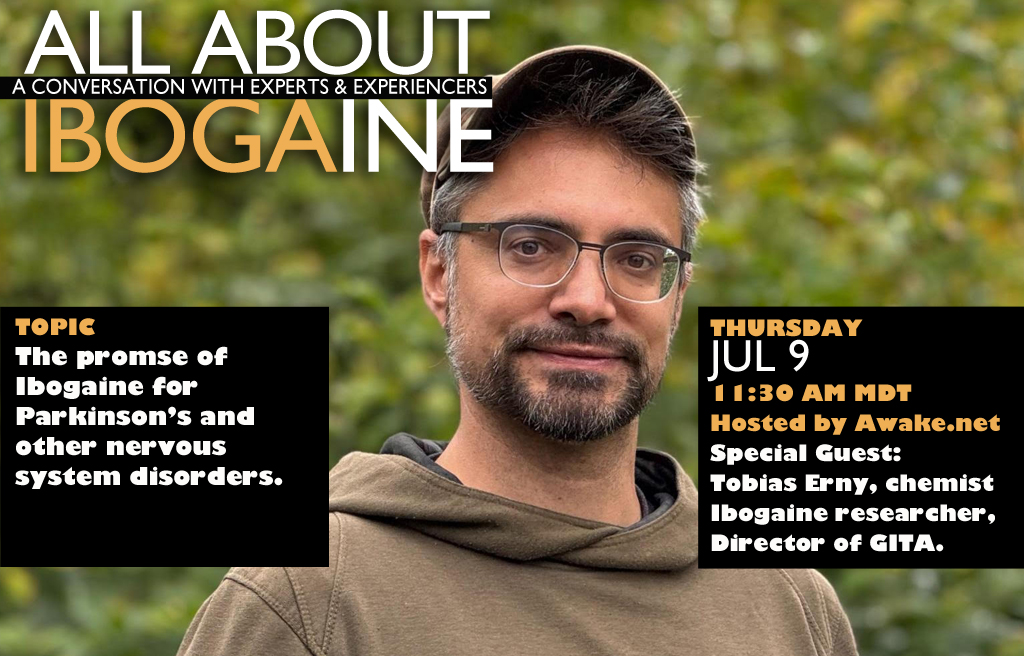
REPLAY of a conversation with Tobias Erny, Swiss-German chemist, ibogaine researcher and Executive Director of GITA, the Global Ibogaine Therapy Alliance, about his origin story with ibogaine and his latest findings about the efficacy of micro and mini doses of ibogaine or iboga in treating Parkinson’s and the potential it has for other nervous system disorders.
[Also Read here a previous Awake interview — a first-person account with the now deceased Patient D who microdosed iboga for years to manage his Parkinson’s and experienced relief and added mobility through his later years until his death at the age of 84.]
July 9, 2026
11:30 am to 1:30 pm MDT
Key Takeaways
- Tobias Erny, a glass technician turned iboga practitioner and author, shared his personal journey from opiate addiction to becoming a leading figure in iboga/ibogaine research and practice in the German-speaking world.
- Ibogaine and iboga root bark differ meaningfully in their experiential and therapeutic profiles; full-spectrum extracts (TA, root bark) are generally preferred by most patients, though ibogaine HCl suits others.
- Ibogaine shows significant promise for Parkinson’s disease through multiple proposed mechanisms: GDNF stimulation, pharmacochaperone effects on misfolded proteins, increased dopamine transporter surface expression, antioxidant enzyme stimulation, and mood/energy enhancement.
- A low-and-slow microdosing titration protocol (starting sub-perceptually, ramping up over weeks) is the current approach for Parkinson’s patients; roughly 40% of patients are non-responders.
- Ibogaine HCl can be safely combined with carbidopa/levodopa; MAO-B inhibitors require caution and individualized assessment.
- A Phase 2A placebo-controlled crossover clinical trial for ibogaine in Parkinson’s is currently in development (ethics committee and funding stage).
- Iboga cultivation is expanding globally (Gabon, Brazil, Australia, Mexico, Costa Rica, Ghana, Congo), and demand is driving large-scale plantation efforts.
- The communal, preparatory, and integrative aspects of Bwiti tradition offer important lessons for Western ibogaine practice.
- GITA (Global Ibogaine Therapy Alliance) clinical guidelines exist primarily for opiate detox and are expected to expand; the organization is currently in a dormant phase but planning new projects.
- Awake.net is building a platform to archive practitioner knowledge and support integration through mentors, complementary modalities, and community resources.
Discussed Topics
Pre-Session Logistics and Platform Introduction
Lakshmi opened the session informally before officially starting the recording at 11:30. Participants were asked to mute upon arrival. Lakshmi introduced Awake.net as an entheogenic platform founded in 2021, designed to archive knowledge from experienced practitioners working with medicines such as ibogaine, iboga, ayahuasca, and psilocybin.
- Details
- Lakshmi: Described the platform’s mission as creating a “living library” of hard-earned knowledge from practitioners who worked with these medicines before public acceptance or regulation.
- Lakshmi: Noted concern about inexperienced voices dominating the current psychedelic space and the importance of elevating those with genuine long-term experience.
- Conclusion
- Awake.net serves as an archival and community platform for experienced entheogenic practitioners.
- Colorado’s psilocybin licensing structure was described as financially prohibitive due to compartmentalized requirements.
Tobias Erny’s Background and Path to Ibogaine
Tobias described his professional background and personal journey into ibogaine use and practice.
- Details
- Tobias: Trained in the chemical-pharmaceutical industry in Basel, Switzerland as a glass technician (developing specialized glassware for chemists and reactors), not a chemist.
- Tobias: Began experimenting with psychedelics and other substances around 2003, gradually developing an opiate (heroin) addiction.
- Tobias: First detoxed with ibogaine HCl in 2006 through the Sacrament of Transition Church in Slovenia, which operated as a legal religious framework for ibogaine provision.
- Tobias: Relapsed multiple times due to proximity to an open drug-use area on his daily commute in Basel.
- Tobias: In 2008, self-administered iboga root bark alone at home — acknowledged as inadvisable — and had a transformative encounter with a plant spirit entity that guided him through energetic healing and self-reflection.
- Tobias: The entity communicated concepts of reincarnation, consecutive consciousness streams, and the need to confront avoided aspects of himself.
- Tobias: Relocated to a different city, breaking the environmental triggers for relapse.
- Tobias: Transitioned from self-healing to helping friends, then friends of friends, and eventually became a professional practitioner.
- Tobias: Around 2010, was approached by the publisher of Nachschattenverlag (publisher of Albert Hofmann, Stanislav Grof, and Terence McKenna in German-speaking regions) to write a book on iboga, which became a standard reference in Switzerland, Austria, and Germany.
- Lakshmi: Drew a parallel between Tobias’s reincarnation insight and the Buddha’s enlightenment through recollection of past lives; shared her own liberating experience with ayahuasca around the concept of death not being final.
- Conclusion
- Personal experience with addiction and iboga/ibogaine was the foundation of Tobias’s expertise.
- Environmental change (relocation) was essential to sustaining recovery alongside ibogaine treatment.
- The distinction between ibogaine HCl (more intrapsychological) and iboga root bark (presence of a guiding plant intelligence/entity) was noted as significant.
Ibogaine and Iboga for Parkinson’s Disease: Research and Clinical Observations
The central technical discussion of the session focused on Tobias’s work with Parkinson’s patients.
- Details
- Tobias: Interest in Parkinson’s began at the 2016 Iboga/Ibogaine conference in Tepoztlan, where Patient D’s videos (showing restored ability to eat and button a shirt) were presented.
- Tobias: Dana Beal introduced him to Amanda Fielding, whose ex-partner (father of her children) had Parkinson’s; iboga tincture was provided and later confirmed effective.
- Tobias: Organized the European Ibogaine/Iboga Forum in Vienna in 2017, which included a video interview with Patient D (still alive at the time).
- Tobias: Began accompanying Parkinson’s patients on low-dose iboga protocols, using validated assessment tools: UPDRS (Unified Parkinson’s Disease Rating Scale), PDQ-39 (quality of life self-assessment), Parkinson’s Disease Sleep Scale, Parkinson’s Disease Fatigue Scale, and Beck’s Depression Inventory (BDI-II).
- Tobias: Conducted baseline, in-process, and post-process assessments; traveled to patients and sometimes worked alongside doctors.
- Tobias: This body of work resulted in a published case report in the Journal of Psychedelic Studies (2025/2026).
- Tobias: A Phase 2A placebo-controlled, open-label, crossover clinical trial is currently being developed (pending ethics committee approval and funding).
- Tobias: Approximately 60% of patients respond; roughly 40% are non-responders regardless of Parkinson’s etiology (genetic, idiopathic, heavy metal/environmental toxins, drug history, head trauma).
- Tobias: Responders can show dramatic results — one patient went from being unable to walk to riding a bicycle again.
- Lakshmi: Shared personal motivation for the topic, having watched her mother decline from Parkinson’s disease.
- Scott (chat): Asked about dosing protocols used in Parkinson’s treatment in Mexico.
- Tobias: Described a titration protocol starting at sub-perceptual doses, slowly ramping up over 5–10 day intervals; after 4–5 weeks of daily microdosing, responder vs. non-responder status can typically be determined.
- Tobias: Rarely sees effects below 20 mg/day of ibogaine HCl; some sensitive individuals (like Patient D) responded to as little as 8 mg; breakthrough results observed at 75 mg/day.
- Tobias: Remote accompaniment is feasible at these low dose ranges (20–35 mg/day); no adverse events observed at these levels.
- Lakshmi: Asked about the neurological mechanisms of action.
- Tobias: Outlined multiple hypotheses: (1) GDNF (glial cell line-derived neurotrophic factor) stimulation — previously researched via invasive intracranial delivery; (2) pharmacochaperone effect — iboga acting as a scaffold for misfolded proteins to fold correctly; (3) increased surface expression of dopamine transporters; (4) optimization of erythrocyte energy metabolism (Roman Paskulin’s research); (5) pro-antioxidant enzyme stimulation; (6) noribogaine’s SSRI-like mood-brightening effect.
- Tobias: Illustrated the multifactorial nature with a case study: a former University of Zurich professor with Parkinson’s, severely depressed and immobile, who after low-dose ibogaine gained motivation, joined a Tai Chi group, and improved posture and gait — not solely through direct pharmacology but through a cascade of effects enabling behavioral change.
- Conclusion
- Ibogaine’s benefit in Parkinson’s is likely multimechanistic rather than attributable to a single pathway.
- A low-and-slow titration protocol is the current standard for Parkinson’s microdosing.
- Formal clinical trial infrastructure is being established to validate informal case report findings.
- Only one case report is currently published; no formal dosing protocol document is publicly available yet.
Drug Interactions: Ibogaine/Iboga with Parkinson’s Medications
Tracy and Michael raised questions about combining ibogaine with standard Parkinson’s medications.
- Details
- Tracy (chat): Asked about safety of combining microdose/low-dose ibogaine with Parkinson’s medications.
- Tobias: Carbidopa/levodopa can be safely combined with iboga microdoses; in best-case scenarios, patients can reduce their L-DOPA dosage, which is beneficial given dose-escalation issues with long-term L-DOPA use.
- Tobias: Dopamine receptor agonists (e.g., D2 agonists) can also generally be combined.
- Tobias: MAO-B inhibitors (e.g., selegiline) are more complex — some patients need less iboga due to potentiation, some experience nausea or headache, and results are inconsistent; not recommended but not categorically contraindicated.
- Michael (chat): Asked specifically about selegiline compatibility.
- Tobias: Advised against combining MAO-B inhibitors with ibogaine but acknowledged some patients do so against advice with acceptable outcomes; emphasized this is not a life-threatening interaction like full MAOIs but requires caution.
- Scott (chat): Raised concern about cumulative noribogaine levels with microdosing leading to QT prolongation and cardiac risk; asked about typical microdosing duration.
- Tobias: Recommends dosing cycles of 1–3 months followed by a rest period; positive effects typically persist for 2–6 weeks after stopping; exact cycle duration is highly individual and determined collaboratively.
- Conclusion
- Carbidopa/levodopa is safe to combine with ibogaine microdosing.
- MAO-B inhibitors require individualized caution; not recommended but not absolutely contraindicated.
- Cycling protocols (1–3 months on, rest period) are used to manage cumulative noribogaine exposure and cardiac risk.
Ibogaine HCl vs. Iboga Root Bark vs. Full-Spectrum Extracts
Lakshmi asked about comparative efficacy and preference across ibogaine formulations.
- Details
- Tobias: Patient preference is partly psychosomatic — pragmatic/rational patients prefer the purity of ibogaine HCl; naturopathically oriented patients tend to respond better to root bark or full-spectrum extracts (TA, tinctures).
- Tobias: Overall, more patients respond better to full-spectrum preparations, possibly due to the presence of other alkaloids.
- Tobias: Ibogaine HCl is gentler on the stomach; root bark can cause nausea in sensitive individuals due to its fibrous, woody composition.
- Tobias: TA (total alkaloid extract) represents a middle ground.
- Tobias: Cost is also a factor — ibogaine HCl is significantly more expensive than root bark powder.
- Tobias: Clinical trials require ibogaine HCl for standardization purposes.
- Conclusion
- No single formulation is universally superior; selection should be individualized based on patient profile, preference, tolerance, and cost.
- Full-spectrum preparations may offer broader efficacy for most patients.
Legal and Regulatory Landscape for Iboga/Ibogaine in Europe
Tobias described the regulatory environment in which he operates.
- Details
- Tobias: In Germany and Austria, iboga and ibogaine are not listed as controlled substances and can be purchased in shops (sold as botanical collector items, gas chromatography samples, or smudging materials).
- Tobias: Legal risk arises when making healing claims or selling for therapeutic purposes, which falls under medical law rather than drug law.
- Tobias: This gray area allows relatively open work with patients compared to the historical situation in the United States.
- Conclusion
- The European regulatory gray area enables informal but relatively open ibogaine practice, particularly in Germany and Austria.
Iboga Sustainability, Conservation, and Ethical Sourcing
Tracy raised questions about ethical and sustainable sourcing of iboga.
- Details
- Tobias: For clinical trials, ibogaine HCl is typically derived from Voacanga africana, reducing pressure on wild Tabernanthe iboga.
- Tobias: Large-scale iboga cultivation is expanding rapidly — plantations of 80,000 plants in Gabon, multiple plantations of 30,000–40,000 plants, and new planting of 5,000–10,000 plants annually.
- Tobias: Iboga is now being cultivated in Brazil, northern Australia, Mexico, Costa Rica, Ghana, and Congo, in addition to Gabon and Cameroon.
- Tobias: A recent ibogaine conference was held in Gabon where local leaders urged increased cultivation.
- Tobias: Ethical concerns include fair pricing for growers, corruption enabled by vague Gabonese laws governing who can grow and sell iboga, and the marginalization of Babongo Pygmy peoples — the original lineage holders who introduced iboga to Bantu peoples — whose habitat is being destroyed by mining concessions.
- Lakshmi: Questioned the legitimacy of any single region or tribe claiming ownership over a plant that can grow globally.
- Tobias: Reported that Bwiti practitioners at the Gabon conference expressed that iboga is “for the world,” though opposing views were also present.
- Conclusion
- Iboga cultivation is growing significantly and supply concerns may be manageable if current trends continue.
- Ethical sourcing requires fair compensation for growers and protection of indigenous lineage holders, particularly Babongo Pygmy communities.
- Gabonese law on iboga commerce remains ambiguous and susceptible to corruption.
Commercialization of Ibogaine and the Risk of Corporate Capture
Lakshmi raised concerns about profit-driven actors entering the ibogaine space.
- Details
- Lakshmi: Noted that many voices in the ibogaine world believe the plant “won’t allow” purely profit-driven operations to succeed.
- Tobias: Observed that large-scale corporate iboga operations have consistently failed; smaller, idealism-driven practices tend to be more sustainable.
- Tobias: Expressed uncertainty about future outcomes but noted the pattern of greed-driven projects not working out.
- Conclusion
- Historical pattern suggests that purely profit-motivated ibogaine ventures tend to fail.
- Humble, idealism-driven practices appear more aligned with sustainable outcomes.
Bwiti Tradition, Ceremony, and Community Integration
Tobias shared insights from his initiation into the Dissumba Fang tradition of Bwiti in Gabon.
- Details
- Tobias: Is initiated into the Dissumba Fang tradition and travels regularly to Gabon to work with local practitioners.
- Tobias: Described the diversity within Bwiti — multiple streams and rites, some opposing each other; some syncretically merging with Christianity (similar to Santo Daime or União do Vegetal).
- Tobias: Highlighted the importance of sincere preparation: plant baths, cleansing rituals, purgative smoothies, and extended preparatory periods before high-dose ceremonies.
- Tobias: Noted that in Bwiti, conditions like schizophrenia or psychosis — exclusion criteria in Western settings — are sometimes treated as indications for initiation, with the community providing sustained post-ceremony support for months.
- Tobias: Contrasted this with Western settings where post-iboga visionary experiences risk being pathologized and treated with antipsychotics.
- Lakshmi: Emphasized the importance of community support and the natural evolution of personal practices through plant medicine work.
- Tobias: Advocated for post-iboga integrative lodges where people can stay for 1–2 months to ground their experience and utilize the window of neuroplasticity.
- Conclusion
- Community, preparation, and sustained post-ceremony integration are critical elements of Bwiti practice that Western ibogaine providers should seek to incorporate.
- Post-iboga integrative residential centers are a significant unmet need in Western practice.
Awake.net Platform and Integration Support
Lakshmi described the Awake.net platform and its role in the ibogaine ecosystem.
- Details
- Lakshmi: Awake.net is building a resource hub combining experienced practitioners (ibogaine, iboga, ayahuasca, psilocybin) with complementary modalities including breathwork, detox, nutrition, and EMDR.
- Lakshmi: The platform hosts weekly “All About Ibogaine” conversations as part of its living library archive.
- Lakshmi: An aftercare program of approximately one week is being developed, with longer-term integration resources also planned.
- Tobias: Expressed strong support for post-iboga integrative centers and the use of the neuroplasticity window.
- Conclusion
- Awake.net aims to serve as a centralized, searchable repository of practitioner knowledge and integration support.
- Practitioners and experts with relevant experience are invited to join the platform.
GITA (Global Ibogaine Therapy Alliance) and Clinical Guidelines
Lakshmi asked Tobias about his role with GITA and the status of its clinical guidelines.
- Details
- Tobias: Is a co-director of GITA alongside Jeremy and Claire Wilkins; the organization is volunteer-run.
- Tobias: GITA is currently in a dormant/hibernating state but has projects in development expected to be published within weeks.
- Tobias: GITA’s existing clinical guidelines were originally developed for ibogaine HCl use in opiate detox.
- Tobias: Acknowledged the need to expand guidelines to cover other substances, conditions, and administration approaches, noting that many providers have developed their own protocols.
- Lakshmi: Suggested a searchable repository of protocols would be highly valuable to the field.
- Conclusion
- GITA’s existing guidelines are a useful but limited resource focused on opiate detox.
- Expansion of guidelines to cover Parkinson’s and other indications is needed and anticipated.



Subscribe to Awake Events & Posts